
Researchers achieve most precise measurement yet of the force that binds nuclear matter
Posted on: 15 June 2026
Trinity's Prof. Stefan Sint, along with collaborators from Germany, Spain and Italy, has published the most precise determination to date of the strong coupling constant. This parameter governs the interactions between quarks and gluons, the fundamental components of nuclear matter. The new result halves the error of all previous experimental measurements combined, setting a new benchmark for the Standard Model, which summarises our current knowledge of Elementary Particle Physics.
This advance will improve our understanding of how quarks and gluons behave inside protons and enable high precision measurements of the Higgs boson and its properties. More generally, improved quantitative control of the strong interactions increases the likelihood to discover effects of yet unknown physics at CERN’s Large Hadron collider (LHC).
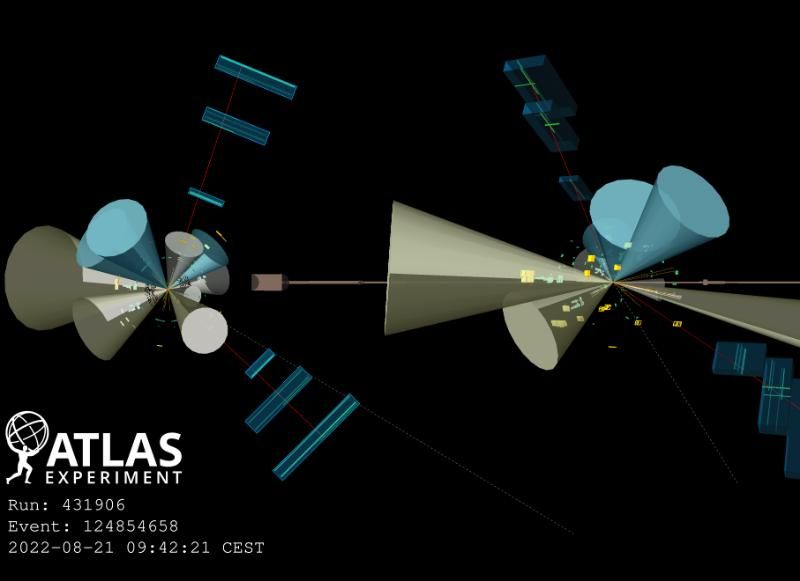
Candidates ttHH collision events in the single-lepton, multi-lepton (SSML) and di-photon (bbyy) final states. The cones represent reconstructed jets, with cyan cones indicating b-tagged jets associated with a candidate Higgs boson. ATLAS Experiment © 2026 CERN. Adapted (cropped) for use. (License: CC-BY-4.0).
Prof. Sint from Trinity’s School of Mathematics was one of the researchers whose landmark results were published in leading international journal, Nature.
“The strong interaction is one of nature’s four fundamental forces,” he explained.
“It binds quarks together via exchange of gluons, and unlike other forces, becomes stronger with distance. This effect, known as confinement, prevents quarks from existing in isolation and makes precise calculations extremely difficult. While LHC experiments at CERN, such as ATLAS and CMS, can estimate the strong coupling constant, their accuracy is limited by confinement models.”
The new Nature study overcame this challenge by using advanced numerical simulations and massive supercomputing power.
Prof. Sint added: “Many years of conceptual progress and work on new numerical methods in large-scale computing made the breakthrough possible, and there is a clear path for further improvement. As a new CERN member state, Ireland now has the opportunity to play a more prominent part in this endeavour, through strengthened support for fundamental research and large scale high performance computing facilities.”
Publication in Nature is rare for theoretical particle physics, highlighting the importance of the achievement. This is further underlined by the invitation of a plenary talk, to be presented by Prof. Sint at this year’s Lattice Field Theory Symposium, Lattice ‘26, at the University of Maryland, USA.
Media Contact:
Thomas Deane | Media Relations | deaneth@tcd.ie | +353 1 896 4685